 info-adolescentsinresearch@hiv-research.org.za |
  +27 (0) 21 301 2020


Adolescents in
Research
toolkit
An online comprehensive clinical, logistical, ethical-legal resource to facilitate the safe and effective involvement of adolescents in implementation and other health research in sub-Saharan Africa.
Purpose and scope of Adolescents in Research toolkit
The Adolescents in Research toolkit provides practical advice to researchers designing and conducting health research to ensure the safe and effective involvement of adolescents in sub-Saharan Africa. The Adolescents in Research toolkit focuses on providing information on best practice for adolescent involvement in research, outlines ethical-legal ‘good practice’ requirements to involve adolescents in research, and aims to provide a comprehensive logistical process for health research.
Who should use the Adolescents in Research toolkit?
Anyone working with adolescents in research, or implementing adolescent research, regardless of your experience in research or where you are on the research journey will benefit from this toolkit.
However, BEFORE YOU BEGIN you should already have considered the following:
- What is the question you are trying to answer?
- Where are you most likely going to find the answer?
- The population (research sample) that will be able to answer the question for you (and the assumption is that if you are on this page, you will be using an adolescent research population (10 – 24 years).
- How are you going to find the answer? The methodology of the research to find the answer. Your methodology can be quantitative, qualitative, clinical trial or a combination of methods.
- The legal and ethical requirements of the methodology and the research sample.
- The resource limitations of the research – time, money, staff etc. – in other
words, the research budget.
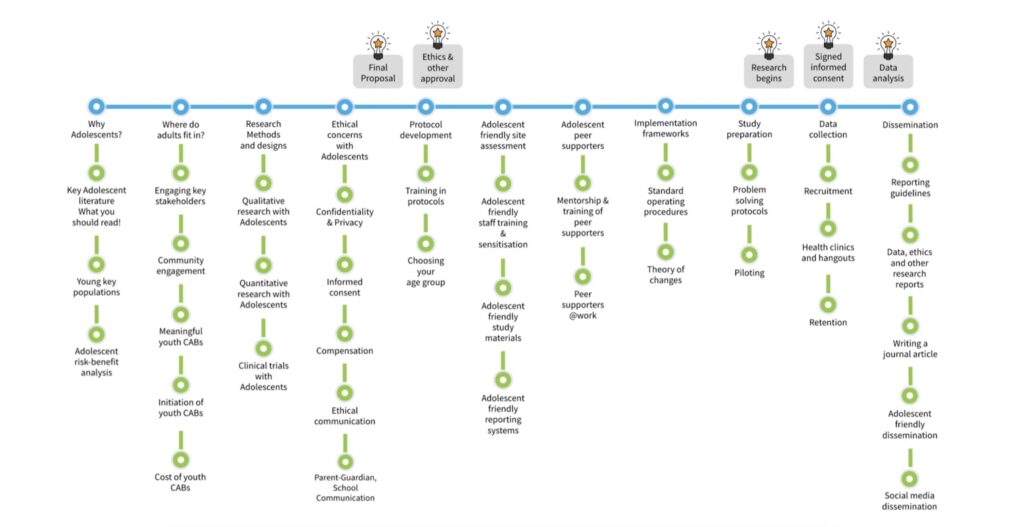
Why Adolescents?
Adolescence, or the second decade of life, is a period in which an individual undergoes
major physical and psychological changes. Alongside this, there are enormous changes in
social interactions and relationships. It is a phase of an individual’s life rather than a fixed
time period; a phase in which an individual is no longer a child but is not yet an adult.
Adolescence is a journey.
Key Adolescent Literature
This is a list of key adolescent literature and is a resource that might be useful to you if you are at the start of your research journey and still need to write your literature review or study motivation.
Young Key Populations
Young key populations (YKPs) are a hidden and vulnerable group of young people (age 10 – 24 years) within the community sectors that are characterised by vulnerability to the HIV epidemic, drug use, sexual exploitation and societal stigma.
Adolescent Risk-Benefit Analysis
Ethical issues in adolescent health research in resource-limited countries.
Before embarking on any research with adolescents, the key question is whether it is absolutely necessary to include or exclude adolescents. This question – to include or exclude adolescents – can be answered by considering and evaluation of the following …
Where Do Adults Fit In?
The involvement of adults, who are parents, guardians, caregivers to adolescents that are under 18 years of age, is required in both clinical and socio-behavioural health research at various stages depending on the nature of research. Here are some ideas on how best to engage adults in adolescent and youth research, even knowing that adult involvement may discourage full and effective participation of adolescents in some research studies.
Engaging Key Stakeholders
Adolescent development takes place within a complex web of family, peer, school, community, media, and broader cultural influences as well as within legislation and regulation frameworks.
Community Engagement
It is never too early to begin engaging with the community.
Health research aims to collect information that will provide a basis for future action.
Meaningful Youth Cabs
The purpose of this station is to assist researchers in setting up advisory boards that promote meaningful and effective inclusion of the adolescents and youth. A strong representation of young people in community advisory boards gives voice to the adolescents and enables them to provide advice on various health issues that affect them such as HIV risk factors, HIV infection prevention mechanisms that appeal to young people, substance use and mental health.
Initiation Of Youth Cabs
While the primary reason for establishing Youth CABs is to invite and infuse the voice of young people in research design and implementation, it should be noted that they need support, upskilling and guidance into their new leadership role. After careful recruiting, selecting and appointing the best young people to serve in the Youth CAB, it is important to initiate them into their role by offering orientation, training and team building workshops.
Cost Of Youth Cabs
The cost of setting up a Youth CAB and the risk of not having a Youth CAB:
Community interactions are dynamic and unique to various contexts and communities. When conducting research or bringing a development programme to a community, it is recommended that practitioners develop context-appropriate, youth-friendly and innovative solutions with the communities.
Research Methods And Designs
Qualitative Research With Adolescents
The focus of this station is to guide researchers on how to conduct effective qualitative research with adolescents and young persons. Using qualitative research methods assists the researcher to explore the different dimensions of adolescent wellbeing in their everyday contexts. We adapt the Gender Adolescence Global Evidence conceptual framework as the qualitative research tool for navigating the health care concerns of the adolescent.
Quantitative Research With Adolescents
Quantitative research methods present many opportunities for meaningful engagement with young and older adolescents. At this station the researcher is reminded of the basic principles of quantitative research and how best to engage adolescents in all stages of HIV and health research.
Clinical Trials With Adolescents
Many of the problems that impact adolescent health are preventable because they stem from behavioural choices, and not physical roots. It is for this reason that clinical research with adolescents often incorporates behavioural assessment and intervention strategy into clinical research. If they do not, they are not addressing issues that place adolescents at the greatest risk.
Ethical Concerns With Adolescents
Confidentiality & Privacy
Respecting privacy and confidentiality in the context of focus group consultations, particularly if the research is within a close-knit community and therefore requires careful reflection.
Informed Consent
It is commonly understood that research, especially in the health sector, is designed to benefit future patients and society and not the individual study participant specifically. It is an accepted central principle that vulnerable people are entitled to a degree of protection that reflects their vulnerability. Thus, research participants should have three types of protection namely …
Compensation
Compensation is intended to compensate participants and or peers for time, inconvenience, discomfort and other research-related burdens (not risks).
Ethical Communication
In trying to address the health care concerns of young people, researchers and health care professionals need to communicate with them in non-threatening and ethical manner. In this regard interpersonal communication skills with adolescents and young people is critical in early identification of health issues, provision of emotional support, effective illness management and health education.
Parent-Guardian, School Communication
Positive relationships with family, friends and school staff are consistently linked with better health and wellbeing outcomes during adolescence, better relationships with school staff were most strongly associated with positive subjective wellbeing.
Protocol Development
The starting point for a good study is developing a good research question and an appropriate study design. Thereafter it is important to write a good protocol or plan to follow. A research protocol is the detailed plan of the study and should be written as the process of writing it up will …
Training In Protocols
Every well-designed clinical trial requires a protocol.
The study protocol can be viewed as a written agreement between the investigator, the participant, and the scientific community. The contents provide the background, specify the objectives, and describe the design and organization of the trial.
Choosing Your Age Group
Deciding on the age range of adolescent and youth participants to be involved in a research project or health intervention will be influenced by the anticipated level of involvement, their level of maturity, and/or clinical requirements of the study.
Adolescent Friendly Site Assessment
Adolescent-friendly spaces are tailored to adolescents needs and are designed to support the research being undertaken. In designing these adolescent-friendly spaces consideration should be given to how much time and when adolescents are going to spend in these spaces and how to accommodate their needs.
Adolescent Friendly Staff Training & Sensitisation
For effective adolescent health care, health care providers and researchers need to be adept at interpersonal communication with adolescents that emphasises openness, trust and respect for confidentiality as it is important that adolescents see healthcare clinics as a safe place to obtain information and a place where they can go in crises.
Adolescent Friendly Study Materials
Adolescents in Research Toolkit uses the WHO’s expanded definition of ‘young people’ as persons of 10 to 24 years of age1 and focuses on what is primarily called ‘the second decade of life’.
Adolescent Friendly Reporting Systems
The Good Participatory Practise Guidelines for biomedical HIV prevention trials (GPP Guidelines, 2011) note the increasing pressure for researchers to provide research results to all participants. In assisting researchers to design reporting systems and disseminate research results, the guidelines set out an appropriate process that is based on needs of the research participants.
Adolescent Peer Supporters
Peers are the single greatest influence on the lives that adolescents lead and on the adults that they turn out to be. Understanding the peer context is fundamental to understanding adolescents.
Mentorship & Training Of Peer Supporters
Traditionally, senior researchers’ mentor early career less-experienced researchers in the field of scientific research. Through mentorship, scientists share knowledge and skills; andoversee the work of junior researchers and link them to funding and further research and publication opportunities.
Peer Supporters @Work
Adolescence, the period of life between ages 10 – 24 years, is often associated with increased risk taking, an increased need for social connection and peer acceptance, and a heightened sensitivity to peer influence.
Implementation Frameworks
Many interventions found to be effective in health services research studies fail to translate into meaningful patient care outcomes across multiple contexts. Implementation science developed out of the need to address challenges associated with the use of research to achieve more evidence-based practice (EBP) in health care and other areas of professional practice.
Theory Of Changes
A framework is a structure that can help organise the theory that supports or comes from your research. Frameworks can be used both when planning an intervention or when describing the outcomes of an intervention.
Standard Operating Procedures
Standard Operating Procedures (SOPs) are guidelines to reduce misunderstanding within a sector when referring to expected quality outcomes, service efficiency, standard performance and quality outputs. Standard Operating Procedures are needed for all aspects of implementing research, not only providing adolescent services.
Problem Solving Protocols
Using Standard Operating Procedures (SOP) within research – clinical, laboratory and other research – undoubtedly leads to increased uniformity of method and consequent reproducibility of results. Although not essential, it is commonly recognised that the person who carries out the procedure is the best person to write a standard operating procedure.
Piloting
Often people wonder whether a pilot study is qualitative or quantitative. The answer is a pilot study is a preliminary small-scale study of qualitative, quantitative and clinical study to be conducted. The aim is to test the feasibility of the study, be it qualitative, quantitative or clinical.
Data Collection
The purpose of research is primarily to answer the research question through the collection, organisation and analysis of data. Before information can be presented and analysed, the data must be carefully collected, managed and organized. The research design and methodology will determine HOW the data is collected.
Recruitment
Adolescents and young people from all walks of life are spending a considerable amount of time on social media platforms, with the advent of COVID-19 further increasing time spent on mobile devices. This impacts approaches regarding how best to reach young people for recruitment into studies.
Health Clinics & Hangouts
In most countries, health services are provided to the general population – including adolescents – by hospitals and clinics run by the government, NGOs and individuals and organizations in the private sector.
Retention
Adolescent-focused research can suffer from a paradox of participation, as adolescents may be temperamental about their involvement in research, even if the potential benefits of research are personally high for them.
Dissemination
Adults can be well-intentioned, but often, adolescents report feeling that they are tokens (present with a limited voice), decoration (present but no voice), under-utilized, or worse yet, disrespected and manipulated. Adolescents have a different world view to that of adults or children.
Reporting Guidelines
There are international reporting guidelines for every type of research design and it is imperative to ensure that if you are to report on an aspect of a study, you must have included it in the protocol at the outset.
Data, Ethics And Other Research Reports
Data ethics encompasses the moral obligations of gathering, protecting, and using personally identifiable information and how it affects individuals. Research ethics committees are able provide guidance on this and will review proposed data management plans when reviewing research protocols.
Writing A Journal Article
Your research is not complete until your research findings (new knowledge) has been disseminated. If your research findings are not disseminated then the resources committed to the research have been wasted. Writing a journal article is a standard way to share your research findings with your peers and colleagues in your field.
Adolescent Friendly Dissemination
The Good Participatory Practice Guidelines for biomedical HIV prevention trials (GPP Guidelines, 2011) note the increasing pressure for researchers to provide research results to all participants. In assisting researchers to design reporting systems and disseminate research results, these guidelines set out an appropriate process that is based on the needs of the research participants.
Social Media Dissemination
- Set measurable smart goals. Smart stands for specific, measurable, achievable, relevant and time bound goals.
- Identify your audience (i.e., decide who you are talking to). You cannot be all things to all people, and everyone is not interested in what you are doing, so be clear about who you are really talking to.
- Break down where you will find your target audience …
Open Access This article is licensed under a Creative Commons Attribution 4.0 International License, which permits use, sharing, adaptation, distribution and reproduction in any medium or format, as long as you give appropriate credit to the original author(s) and the source, provide a link to the Creative Commons license, and indicate if changes were made. The images or other third-party material in this article are included in the article’s Creative Commons license unless indicated otherwise in a credit line to the material. Suppose the material is not included in the article’s Creative Commons license, and your intended use is prohibited by statutory regulation or exceeds the permitted use. In that case, you must obtain permission directly from the copyright holder. To view a copy of this license, visit http://creativecommons.org/licenses/
This work is licensed under a Creative Commons Attribution-NoDerivatives 4.0 International License.
Please note that this license does not cover the following articles:
- Articles republished from other sites
- Opinion pieces published on this site
Every effort is made to ensure the availability of adolescentsinresearch, but downtime may occur for reasons not under our control.
